An AI model that answers a few questions well is nothing special anymore. What matters now is work that takes hours or days: converting a codebase, running an audit, building a complete app without having to sit next to it the whole time. On 9 November 2026 Anthropic released Claude Fable 5.2 for exactly that, together with its sibling Claude Mythos 5.2.
In this blog post you read what is new, what Anthropic and early users did with it in the first days, what it costs, and when to use it and when not.
What has changed?
Fable is the model Anthropic points to for the hardest work, a step above Opus. Version 5.2 succeeds Fable 5.1 and mainly brings this:
Better at code, reasoning and vision. Anthropic reports progress on all three.
Up to 30% faster output than Fable 5.1, and testers say the model communicates more clearly.
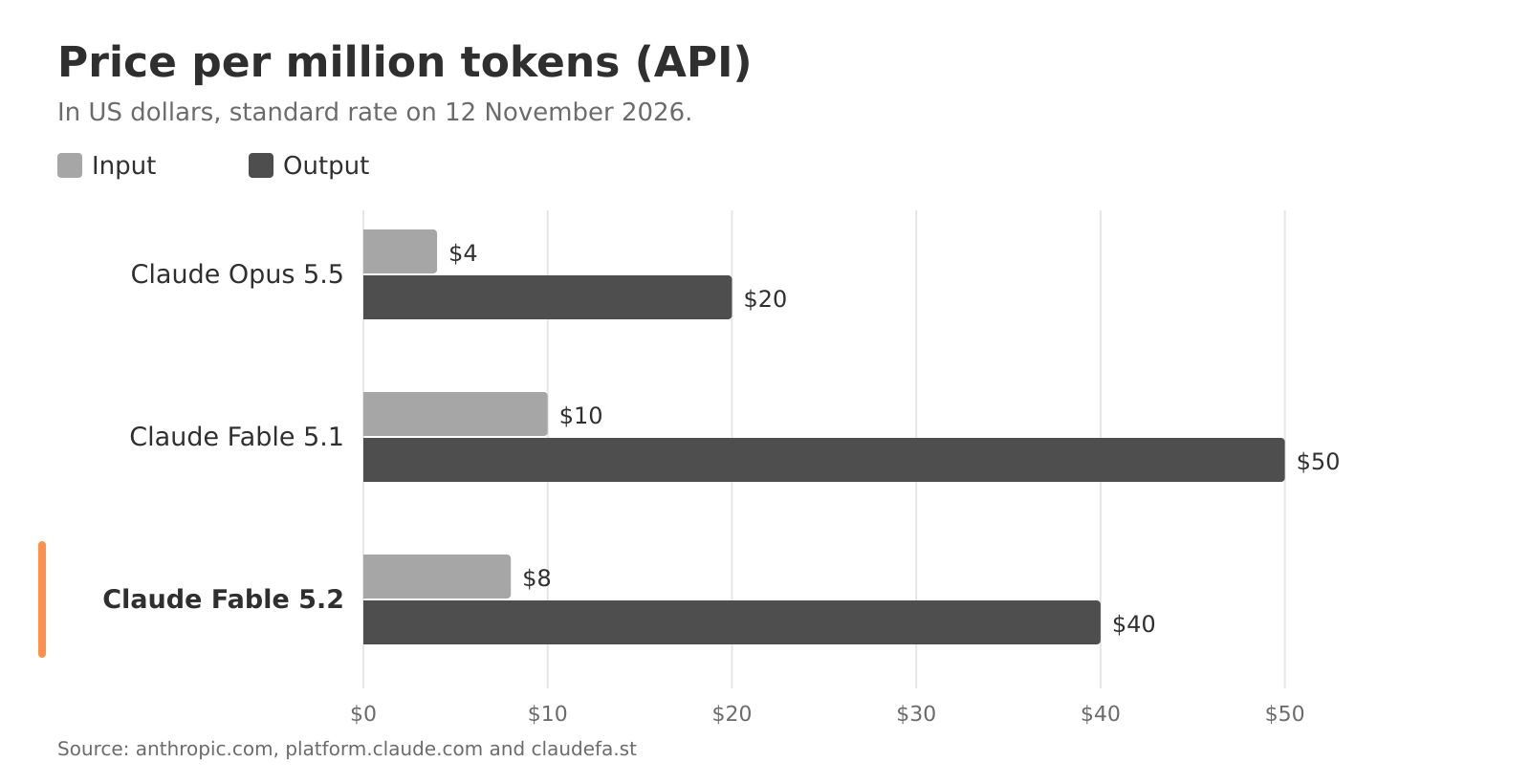
A lower price. Through the API, Fable 5.2 costs $8 per million input tokens and $40 per million output tokens, against $10 and $50 for Fable 5.1. There is also a fast mode, up to 2.5 times faster, for $16 and $80.
A conductor for other models. Fable 5.2 can act as an Advisor that smaller models consult on hard problems, or as an Orchestrator that leaves simple tasks to smaller models.
A large memory. A context window of 1 million tokens and up to 128,000 tokens of output per answer. The model always thinks adaptively; the effort setting (from low to max) decides how much.
Claude Mythos 5.2 is the same underlying model, with wider limits for cybersecurity and biology. Directly, it is only available to organizations Anthropic approved through its Cyber or Life Sciences verification program; Claude Enterprise customers also get it through Claude Security. Fable 5.2 is widely available: in the Claude apps (depending on your plan), in Claude Code and through the API on Anthropic’s own platform, Amazon Bedrock, Google Cloud and Microsoft Foundry.
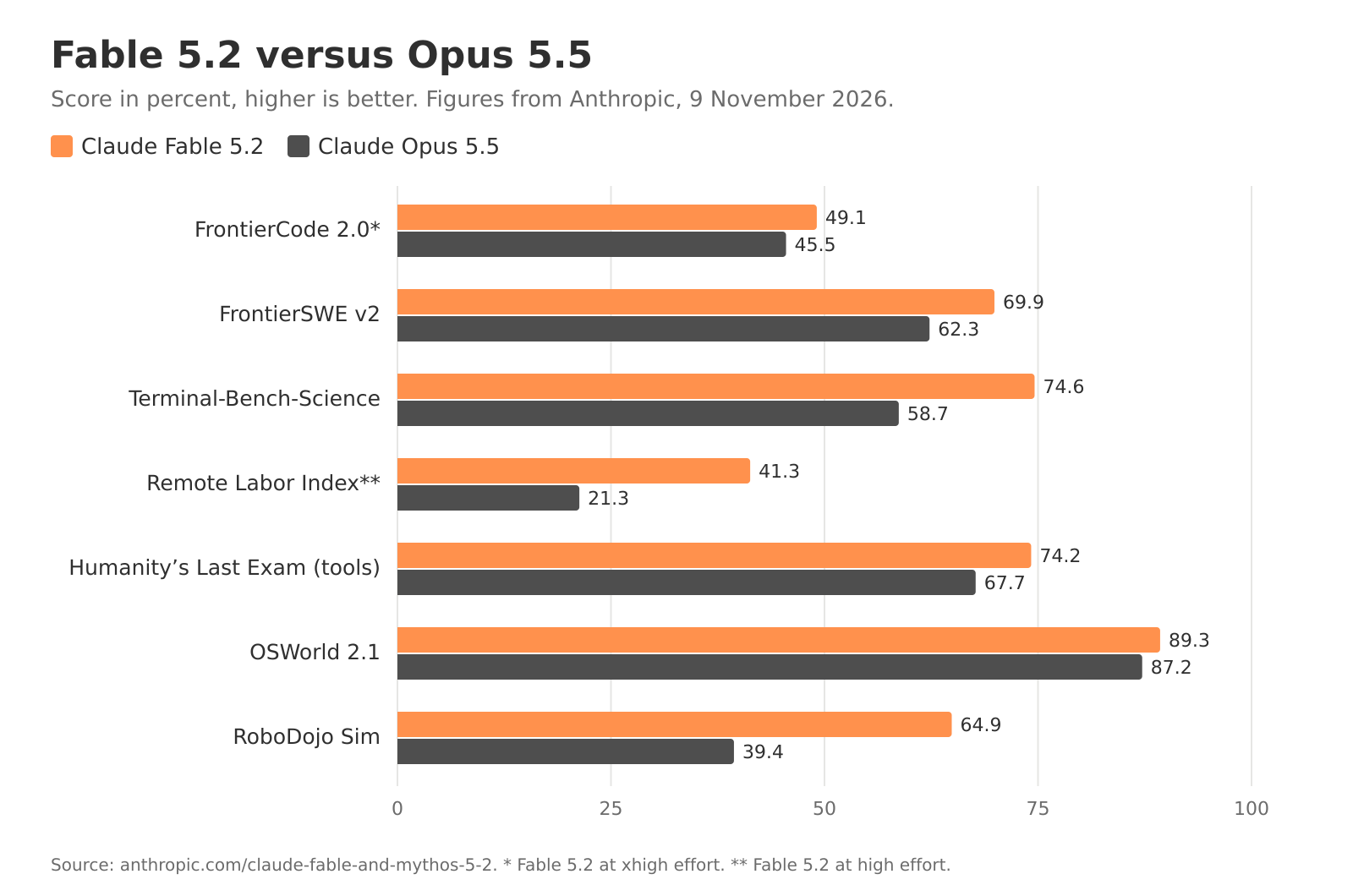
Fable 5.2 does not win everything. In Anthropic’s own table, Gemini 4 Carbon scores higher on AutomationBench and Opus 5.5 keeps a higher Elo score on AA-Briefcase. The FrontierCode score in the chart is Fable’s at the xhigh setting. The price per task stands out, though: at the high setting, Fable 5.2 reaches about the best FrontierCode score of Opus 5.5 for about half the cost per task.
What Anthropic had it do
The examples in the announcement show what this model is meant for: long, large and independent work.
An operating system from scratch. An engineer had Fable 5.2 direct more than 1,000 subagents for eight days. From an empty folder came an OS that boots on a laptop, with drivers, file storage, windows, a login screen and an installer.
A migration to Rust. Agents running an early version of the model moved a critical production service from Python to Rust. That service now starts about 26 times faster.
Three working devices. From one paragraph of text, Claude designed, together with circuit board maker Diode, a voice-assistant hub, a USB speakerphone and a handheld virtual pet: circuit board, 3D-printed enclosure and software. All three worked without electrical modifications.
Mathematics in 30 hours. A team of 1,000 Fable 5.2 agents formalized Fermat’s Last Theorem in Lean in about 30 hours, with, among other things, 47 proved lemmas from the first attempt as a starting point. That first formalization took 11 days.
Physics and robots. The model solved two open problems about black holes and quantum gravity, and controlled robots on tasks such as solving a puzzle cube and unscrewing a bottle cap.
What customers report
Companies with early access mainly describe less correcting and more reliable work:
Vercel saw projects finished in days instead of weeks, without having to correct the model again and again, and with fewer comments from the reviewers.
Uber ran a security audit of 10 to 12 hours with about 170 reviewer agents.
Oracle got the right result in a test with enterprise SQL, where two other models summed values incorrectly and came out 5 to 8 times too high.
Box saw the model flag an inconsistency in a loan application: salary deposits that did not match the bank balance.
Cognition finds that the model says when it does not know something, instead of making something up.
What people are already building
Outside Anthropic, the first stories are appearing from makers who describe their own project, next to an overview by MindStudio of demos by testers. Some of them could use the model before the release.
A game for a nephew, mostly overnight. In June, Lex Toumbourou had made a first version of a beat ’em up based on his nephew’s drawings, with twelve bosses and a puppy to rescue. On 10 November he described how, before going to bed, he gave Fable 5.2 in Claude Code one detailed prompt to finish the game and make it as fun as possible. That night the model rewrote most of the code and had image and audio services make about 175 images and 140 audio clips. The game got cutscenes, an ending and four-player co-op with controllers; after playtesting with the family, playable family members were added. A bot the model wrote itself played through all twelve levels in a browser and checked the screenshots. Over two days and about 600 requests, the total for Claude came to about 340 million tokens, most of it from the cache.
Hundreds of worlds from one paragraph. Ethan Mollick, who could use the model before the release, describes how he started with one paragraph and let agents keep building, steering now and then. After 20 hours there were 204 worlds, later more than 450, all drawn live in code. He is critical too: the quality was uneven, and in his projects the agents did not notice by themselves when their work was too long, repetitive or dull.
A dashboard in five minutes. On 9 November, Griffin Wooldridge had it build a finance dashboard in Claude Code in about five minutes and a landing page in about twelve; that last brief ran in two sessions at once, each with its own style. The model looked at its own pages in a browser and fixed part of what was wrong. One of the two landing pages did contain invented figures, which you have to replace before publishing.
Big demos from testers. According to an overview by MindStudio, testers each started from one prompt and built a spreadsheet app in the browser with formulas and pivot tables (about 50 hours of building time), a video editor for Windows with a timeline and keyframes, and a multiplayer party game with ten levels.
Small, affordable projects. The same testers also made a physics simulation of a bullet passing through a water balloon (around $91 in API costs) and an optimizer for 3D-printable towers (around $37).
💡 The big games and app clones are mainly a demonstration of what is possible, with billions of tokens and thousands of dollars in API costs. Testers themselves call Fable 5.2 a solid, incremental improvement over Opus 5.5. What impresses is mostly how long it keeps working on its own.
📚 Want to see for yourself? Lex Toumbourou’s game can be played in the browser, and his blog shows his nephew’s drawings next to the game characters. Mollick and Wooldridge show screenshots of their results in their articles.
What does it cost?
Fable 5.2 is cheaper than its predecessor, but per token still twice as expensive as Opus 5.5. Anthropic itself advises starting daily work with Opus 5.5 and only moving up to Fable for the hardest tasks, or down to Sonnet 5.5 or Haiku 5.5 for simple work.
When do you choose Fable 5.2?
Choose Fable 5.2 for work with many steps, a lot of context and room for its own judgment:
rebuilding or migrating a large codebase;
an audit or review in which many agents work at the same time;
building a complete app, tool or game from a clear description;
research in which the model has to decide what the next question is.
For a quick question, a short script or an email, Opus 5.5 is half the price per token. Within a large job, Fable as Orchestrator can leave simple subtasks to smaller models itself.
Wrapping up
Fable 5.2 is not a new kind of AI, but it is a model that is faster and cheaper than its predecessor and built for long, independent work. You see that in what gets built with it: from an operating system to a game for a nephew. Want to try it yourself? Start with one job you would normally give a colleague for a few days.